Here they are!
Umbria and the Marches
Enjoy!
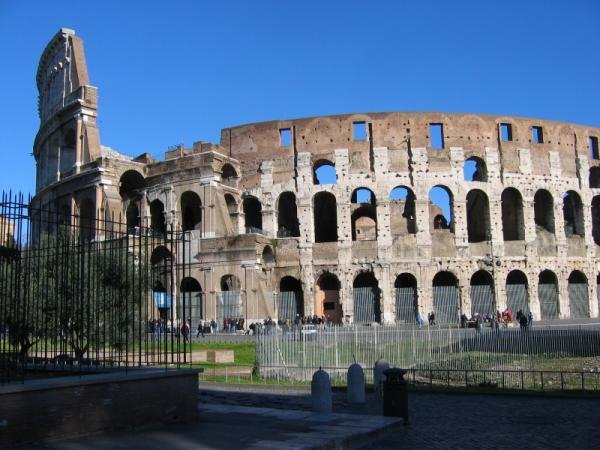
Yes, I know this isn't Florence
November 22, 2007
November 21, 2007
Urbino-Monterchi-Sansepolcro
Next morning we ate a pretty lackluster breakfast before boarding the bus and heading about an hour to Urbino. Our first stop was the (unheated) Ducal Palace. It’s now a museum, holding quite a number of artworks that really don’t necessarily have anything to do with Urbino. A few that do, however, are Raphael’s La Muta and a really tiny painting of St. Catherine. Raphael was born in Urbino, you see, and his father was a court painter for the duke, Federico da Montefeltro. More interesting was Piero della Francesca’s Flagellation and Madonna of Senigallia. Two other works I had studied in slides were also to be found there: Luciano Laurana’a View of an Ideal City, possibly done from a drawing by Bramante, and a portrait of Federico and his son Guidobaldo by Pedro Berruguete. The other (really, really) interesting item there was the study of Federico da Montefeltro, paneled in illusionistic wood intarsia with virtues, a portrait of the duke, still life objects, and landscapes. I can’t imagine how many people and how much time it must have taken to finish that room.
After leaving the ducal palace, we hiked up one of Urbino’s steep hills to Raphael’s House, now a museum which still possesses much of the original furniture. It was really interesting. We saw the room where Raphael was born which has a little fresco the people like to say is an early Raphael. We also saw the grindstone where his father powdered his pigments. The house was on three levels, with a fourth area connected by a little courtyard on the second level which was overlooked by a balcony. Raphael’s father must have done quite well.
We then quickly ducked into two oratories, admiring frescoes in one and sculpted stucco in the other, before going to lunch. My friend Meg and I followed Helen (who always knows the best area restaurants) to a little place called the Fornarina, in honor of Raphael, and ate with Helen, Collette, another student named Claire, and the bus driver. It was pretty interesting since almost all of the conversation was in Italian. Obviously, my language skills are basic enough that I mostly listened but I was still able to understand quite a lot. One rather funny cultural clash occurred. As it was bitterly cold outdoors, Meg ordered hot tea to go with her pasta. The bus driver whipped around with the most dramatically shocked look on his face and exclaimed, “Tea?! With pasta?” and went on to say that tea was only good for 4 o’clock. After this, I had to order it, too. After the waiter had left he was mumbling drinks that would have, in his eyes, been more appropriate for a lunch, ending his list with water. I shrugged and said, “È fatto con l’aqua,” to which he was only able to smile while the rest of us, Americans, laughed. I ordered some sort of egg pasta with porcini mushrooms and had a piece of torta della nonna, a lightly lemon-flavored creamy tart with pine nuts on top. It was all very good.
Piling back on the bus, we drove over 2 hours to the little town of Monterchi where we got off the bus just long enough to see Piero della Francesca’s rather strange Madanna del Parto, which presents us with an image of the expectant Virgin.
We then drove about 15 minutes to Sansepolcro, Piero’s hometown, where we quickly went into the Cathedral to see a Resurrection altarpiece influential on one of Piero’s most famous works. We then saw this piece, also a Resurrection, at the Civic Museum. It was so powerful: the look Christ fixes you with seems to sum up the entire Passion. We also saw his Madonna of Mercy altarpiece and two fragmentary frescoes, one of St. Julian, the other of St. Louis of Toulouse. There was also a rather interesting display of old, intricate keys and locks. After stopping at a café, it was time to head back to Florence, a trip that took us over 2 hours, lengthened by an unexpected detour due to road construction. It had been so bitterly cold in the mountains that it felt positively balmy when I stepped off the bus!
Arezzo-Assisi
This past weekend I went on a two-day Early Renaissance class trip in Umbria and The Marches. It was nice to go on one of these when I didn’t need to worry about taking notes! We rode in a chartered bus the entire time, as trains and public buses do not go to some of the places we went.
Our first stop was in the town of Arezzo, for which I was very excited since it’s the sight of the movie La Vita È Bella. I only recognized the main square but I was pretty excited about that nonetheless. We first visited the Legend of the True Cross fresco cycle by Piero della Francesca in the church of San Francesco. I think I ought to mention at this point that though I was extremely excited to be there and had fun during the entire trip, it was miserably cold! Unfortunately, it was probably the approximate temperature I would be used to at this time of year in Iowa; I’ve just been rather thoroughly spoiled by the environment enjoyed in Tuscany.
The fresco cycle was incredible, as are pretty much all of Piero’s works. We studied him and his relationship with the Duke of Urbino at length in my intro to renaissance art history class at the U of I. He is so detailed. I imagine him doing hundreds and hundreds of studies of the tiniest little details for use in some of his finished works. One thing that’s interesting about the battle scenes in this fresco cycle is that because they are so detailed and life-like, scholars think he may have witnessed the actual Battle of Anghiari, the subject matter for now-lost epic fresco by Leonardo da Vinci, which took place near to where he was living at the time.
We then stopped into the Badia which had a faux dome by Vasari, a native of Arezzo, like the faux domes of the Jesuit churches I saw in Rome. There was also a really large altarpiece Vasari painted to adorn his tomb, though he is now buried somewhere else.
Next was a large Romanesque church, Santa Maria Pieve, where the Early Renaissance class looked at an altarpiece by Pietro Lorenzetti. I listened to a quintet that was practicing for a concert that evening. The church had magnificent acoustics. In fact, when we went behind the church into the main piazza, we could still clearly hear them singing over Helen’s discussion of the Joust of the Saracen, a really strange festival that takes place annually in that square. After seeing a Mary Magdalene fresco by Piero in the Gothic Cathedral and an Italo-Byzantine cross by Cimabue in San Domenico, we then quickly visited Vasari’s house, which was a pretty interesting example of an artist’s home in the mid 1500s.
We boarded the bus for a 1 ½ bus ride to Assisi during which we all ate our picnic lunches and enjoyed the views going past the giant Lake Trasimeno. The lake is the site where Hannibal of Carthage defeated the Romans in a bloody battle but is also home to an island where St. Francis is said to have fasted for 42 days, eating only a loaf of bread the entire time.
In Assisi it began to snow while we climbed our way up to the church of San Francesco. We examined the decorations of the lower church, the one begun shortly after the death of the saint in 1226, before going down into the appropriately bare and austere crypt where Francis is actually buried. Speaking is absolutely forbidden. We then climbed to the upper church with its extensive series of frescoes, many of which illustrate the life of the saint. There is a lot of debate over who did the frescoes, however. The church and Italy in general maintain that they were all done by Giotto, which would make them quite the national treasure. However, it looks much more like someone copying Giotto’s style did them. A lot of the scenes don’t have Giotto’s clarity or simplicity and were done in too many giornata (frescos are done one puzzle piece at a time, each piece representing a day of work since the plaster dries in about 8 hours). Landscape and architectural elements are also a bit off and it looks like several hands had a help. However, there are two frescoes on the entrance wall which look a bit more convincing. Maybe they’re the real thing
After leaving San Francesco, we walked across town to Santa Chiara. The town of Assisi is so romantic and picturesque! All of the buildings I remember seeing were made of stone with adorable, thick wooden doors. The streets were clean and the mountain air was clean. It was really, really cold, though! In the church, service had begun so we were only able to go to the crypt to see the saint’s sarcophagus. It was mildly interesting. Of much greater interest was the incredible sunset over the mountains across the wide valley! The snow clouds made a pretty dramatic contrast with the tropical-coral of the sun.
In the valley was the town of Porziuncola where we visited Santa Maria degli Angeli, a huge church erected over the Porziuncola—the humble little chapel in which St. Francis actually founded the Franciscan order—and the bare-earth spot where St. Francis died. On the way in, I observed a large sign about St. Elizabeth with an illustration that made her look like a Disney princess.
We got back on the bus and headed for the extremely small mountain town of Lamoli where we were to spend the night. I fell asleep and woke up with the bus creeping up the snowy switchbacks of a mountain pass. I had never really pictured this about Italy. We eventually rolled into Lamoli and up to our hotel, Oasi San Benedetto, which was a remodeled monastery. After dropping our suitcases, we headed down to the dinning room and a banquet-style dinner with bread, pasta, lentils, chicken, and a dessert which was like a spongy cake with some green raisin thrown in.
After staying up and talking, I went back to my room, attempted to get warm, and finally fell asleep.
Pictures for Germany and Certossa di Galluzzo
Like the title says, here are links to some pictures that go along with my last few posts. Enjoy!
Germany
Certossa di Galluzzo
The buttons for subalbums are now on the side of the page as opposed to the bottom.
Germany
Certossa di Galluzzo
The buttons for subalbums are now on the side of the page as opposed to the bottom.
Certossa di Galluzzo
Last weekend, my High Renaissance class did some visits around Florence that would not fit into regular class time. Firstly, we went to a hard-stones museum where we saw several examples of a type of mosaic invented during Mannerism here in Florence. There were also displays which endeavored to illustrate the procedures for working in this craft. It looked too tedious even for me.
Next we went to Santa Felicità to look at the Capponi Chapel wherein one finds Pontormo’s masterpiece, The Deposition. I enjoyed this visit so much that I decided to switch my paper topic from an examination of Michelangelo’s three Pietàs to a discussion of this painting, an infinitely more difficult topic as there is not nearly as much scholarship on Pontormo as there is on Michelangelo. To be entirely honest, I had not even heard of him until we began to cover Early Mannerism in this class. But, then, my knowledge of Early Mannerism and the Maniera is admittedly rather scant.
Our next stop was Palazzo Vecchio. Of course we went to the Sala dei Cinquecenti where we saw the Vasaris that cover Leonardo’s Battle of Anghiari and the place where Michelangelo was to paint his Battle of Cascina. As a matter of major interest, some scholars think that Vasari may have left Leonardo’s work unharmed in the same manner in which he preserved Masaccio’s Trinity when the granduke had him paint over it. There are apparently going to be some tests done to determine if it’s there or not. Also in this room was Michelangelo’s Victory, one of the Julian statues that never made it on the tomb.
We also got to see a secret alchemy study built by one of duke Cosimo’s sons to escape from politics into his favorite subject. It was really neat, with little doors revealing windows and cabinets and even passageways. We followed one of the passages to little tiny reading room which could have been made more cozy only by the addition of a little fire place and some hot soup.
Finally, we saw many frescoes by various Mannerist artists, Bronzino being the one I remember most (probably because we just studied him today in lecture), before going on lunch break. As it had been freezing cold, I rushed home and changed clothing and grabbed a heavier coat before eating and then hiking to the Santa Maria Novella bus stop. We all got on an unbearably crowded bus and headed to Certosa di Galluzzo, a monastery outside of Florence’s city walls which was Pontormo’s home for 3 years during a resurgence of the plague. There we saw some lunette frescoes by him in very bad condition owing to their long exposure to the elements. Most of his compositional elements in the frescoes came directly from a small print series of The Passion by Durer, a source of inspiration for which he was heavily criticized. This is because Italian artists felt that the Germans were barbarians who ought to learn art from Italian, not the other way around. His colors, though I realize they are not all in their original condition, were really amazing. The way he used green for shading pink cloth, or purple to shade yellow was both unexpected and delightful. A lot of his shapes have very abstract qualities, as well, putting the emphasis on the abstraction of composition. I was really impressed and took several photographs.
We wandered around the rest of the monastery, looking into one of the apartment cells open for exhibition. This was a really swanky monastery: each monk had his own garden, well, bedroom, living room/study, and little library area. I guess the catch was that they were sworn to permanent silence. It’s actually still a functioning monastery, just for a different order so that when we went into the little shop, the monks were allowed to communicate with us. I bought some little honey candies.
Germany, Days Four-Six
On my fourth day, Tuesday, I went into Wiesbaden with Christine with the intention of shopping. We ate lunch at a cafeteria where every week Christine goes to have the fish. I had a dish that was like marinated roast beef with potato dumplings and red cabbage sauerkraut. Of course, its name was something miserably long and impossible to remember so you’ll forgive me that I’ve forgotten it by now (indeed, I don’t think I ever really knew it). However, I enjoyed it very much.
We then went to an eyeglasses store where Christine tried on several pairs (so did I, just for fun) and I helped her choose between two styles. We also picked up some cologne at a large perfumery at Erin’s request (for her boyfriend?). Then we headed over to a clothing store, where I found a rather classic black dress that after trying on I decided I was going to buy. Christine had me hand it to her through the dressing room curtain to hang up and get in line with but when I found her again she had already purchased it for me! She said it was her present to me for “being the first out of the family to visit us.” It was so sweet! We also went to another store where I bought some black pants.
Later that night, after a peanut butter and jelly sandwich, I went to a grocery store with Christine. It was pretty interesting to see what they had available in comparison to both American and Florentine grocery stores. I thought it much more resembled American stores. Christine picked out a number of commercial sweets for me to try. We also went to a warehouse Sam’s Club type store called Metro to purchase articles for Christine’s bratwurst stand.
When I woke up on Wednesday, Jim told me not to eat because he was planning on going to the bakery and coming back with the bread for a traditional German-style breakfast. The bread was amazing and we ate it alternatively with butter and cheese or butter and jam. I remember most specifically a delicious roll with pumpkin seeds on top.
After getting ready, we went to Frankfurt and drove around, Jim pointing out buildings or sites of interest. We then went on to a small town, the name of which I cannot recall, to visit Christine’s stand. It was so cool! It was set up on one of the little Italian trucks I daily see rolling down the narrow streets in Florence. Of course, I had to try one of the wursts. It was so good! Christine drives all the way to Limburg to buy them.
We watched Christine’s steady stream of customers for a little while (I did some videotaping) before we got back in the Smart and drove the rest of the way to Heidelberg. It was beautiful! The town is built along the Neckar River but sort of splashes up the sides of the mountains that surround it, reaching the schloss (palace) that overlooks and crowns it. The castle was in much better condition up to WWII, when it suffered a bombing. We drove there first, winding up the mountain side until we found a bus parking lot where the attendant let us leave the car. We walked first to the edge of the schloss’ wall where there was a splendid view. I took some video of Heidelberg, in lieu of photographs. I guess that’s my apology for not having very many pictures of Germany, though I enjoyed it even more than some of my trips in Italy. Maybe I also wanted to just experience the place instead of using all of my time to photograph.
We then went in the castle’s courtyard area. Jim and I agreed that it looked very “Harry Potter-ish.” It spilled out onto a terrace that also had an incredible view of the valley. Jim pointed out a path visible on the opposite mountain called The Philosopher’s Way.
We went into a wine cellar where there was located the largest barrel I had ever seen or imagined seeing. It filled an entire room and had a platform built on top accessible by two staircases. We went up the stairs and looked around, mainly because the network of little walkways and the old spiral stairs at the end were so interesting. Leaving the cellar area, we walked across the courtyard to a series of rooms set up as a sort of apothecary museum (pretty random, I know). The large wall above the door to this museum was very interesting because all of the roof and glass were gone while the wall behind it was also missing, giving it the look of a movie set. Inside the museum, we could see some of the structure of the castle, which many times proved to be several feet thick where pierced by the occasional window. In a basement area there was also an alchemy lab set up, displaying much of the equipment used for distillations.
While we were looking at some various strange items used medicinally in the past, Jim pointed out a sentence in one of the descriptions, all of which were given in German. He began to tell me what it meant and I was able to really surprise him by translating the final word, “gift.” It means “poison” in English and I know it because my sister took German and was infinitely amused by this coincidental association.
We then left the interior and walked around the grounds, coming to a final, spectacular view that now encompassed not only the valley below but the schloss we had just explored. The light was also incredible, the sun having just started to disappear behind the mountains but still striking their tops across the valley.
We went back to the car and then down into the town proper where we found a parkhaus and then walked around the adorable buildings. We went into a hall church there, with its incredible emphasis on the vertical and its narrow, tall stained glass windows, plainly unlike the many Italian churches I had visited. Some of the stained glass was clearly a modern contribution, celebrating God in a strictly non-objective manner and with streamlined craftsmanship.
We then went to a lovely bridge over the Neckar that Jim had pointed out from one of our views above. It was called Old Bridge, although it really only originally dated from the 1700s. It was apparently destroyed just as WWII was ending, but rebuilt on the same plans. On one side it was flanked by a large gate with two little towers. It had a very nice, valley-level view of the town on the mountain and along the river. It was also quite cold by that time, the sun having sunk away almost completely.
We began looking for a place to eat, finding after a little search a homey German-style restaurant. It was so warm! Jim and I sat near the front and I was able to watch the patron in the restaurant as well as passersby outside. We sat and talked, he ordering a deer meat dish (I tried it and found that it was very good), me ordering beef and onions with spaetzle. We also had apple strudel with coffee for dessert. It was extremely hearty and delicious.
The next day I had to pack all of my things to leave in the afternoon. Jim suggested that, since it was in the area of Frankfurt-Haun, we should drive to a castle above Bernkastel-Kues, a town along the Mosel River. Of course this sounded like an excellent idea. On our drive, the weather oscillated between clear and “Grimmy,” settling on Grimmy around the area of the castle. We drove up an unbelievably narrow road (2-way, nonetheless), parked, and approached the castle from above. As we walked the sun was burning through the mists and slowly more and more of first the castle, then the surrounding vineyards, and finally the valley and town below were revealed. It was stunning. The castle was very plain and a bit ruinous but all the more ancient-looking for it. Inside, a restaurant had managed to place itself into one of the walls, setting tables out-of-doors for use during better weather. A terrace before the entrance looked over the whole valley below. The mountain walls were alarmingly steep, especially since they were covered with grapevines. I would not have wanted to try to walk up and down those lines, harvesting the grapes, for fear of falling and not stopping until sometime next year.
After trying my hardest to fully take in the golden trees and grape leaves, blue, sparkling river, lingering mists, and little red-roofed houses, we walked back to car in order to drive to and walk around the very well-preserved Bernkastel-Kues. We ended up finding a parking lot along the river and taking a sort of whirl-wind walk around the center, as my remaining time in Germany was running very short. But surrounding one of the squares were incredibly old half-timbers, excellently cared for, though often leaning. These were flanked by little narrow roads over which were often raised wire forms with twisting vines, still green and occasionally flowering. It really was a fairy-tale effect.
But now it was time for me to leave and we drove to the airport, getting there with a rather scant 45 minutes for my check-in. As there was no line, however, this did not matter and I was able to easily grab my boarding pass, say goodbye to Jim and get in line for the X-rays. I must admit, even though I was going back to Florence, a place I have dreamed of seeing, I was very sad to leave Germany. I’m so happy I got the chance to visit my uncle and aunt there.
The flight went smoothly. I sat by a married French couple about my own age and watched the approach and journey over the Alps between chapters in my book. Once in Pisa I had a bit of a hassle getting a train ticket back to Florence, but still made it back to my apartment before 9.
November 7, 2007
Germany, Day Three
The next morning, before showering, Jim and I took the two dogs out into the country on a walk. It was rather foggy and cold, but we could still discern houses on distant hills and enjoy the beautiful yellow and orange woods. Jim often runs in this area. He told me a very unusual story in which he was actually run over by a deer. Basically, it sprang from the woods and knocked him over into the snow. Ouch.
After cleaning up, we went to a picturesque little town called Eltville Am Rhien. As its name suggests, it was located along the river Rhine. We began a walk along the river’s shore, looking at some of the impressive buildings across the water or down the shore from us. We turned into a little courtyard area where the berg (castle) was located and went into its walled garden. Poor Jim: I had to look at everything. I even made him pose for a picture. We climbed all around the wall area, eventually making our way into the rest of the town. This was comprised of impossibly fairy-tale-like cobble streets and half-timber houses, restaurants, and wineries (being one of Germany’s wine regions). After walking all over the town and taking many pictures, we made our way back to the “Smart” (when in Rome, people) and headed towards Mainz before it got dark. At some point Jim tried to apologize for the prevalently misty weather but I stopped him and observed, much to his amusement, that it was just “Brothers Grimm weather.” For the rest of the week, if it clouded up or got misty, Jim noted that it was getting “Grimm-y.”
In Mainz, after leaving the Smart in a parkhaus, we walked to a square that opened up in front of a very large church. We were both very hungry (nothing had actually been open in Eltville), so we went into a chain café. I ordered a cheeseburger. I know that’s terrible and all but I figured it was a chain and that missing its German food probably wouldn’t hurt me. Of course, this was also a bit out of character for me. I never order hamburgers in restaurants in the States but being away for two months can give you weird, insurmountable cravings, especially when your diet has been consisting primarily of salad and pasta.
Here, too, we walked down to the Rhine and made our way along its edge, although it was quite dark by then. We observed, on our way down, a lady cop writing a ticket for a parked car and taking quite a lot of pictures of the interior. Either there was something of interest in it, or Germans are just really thorough. What I can say with some certainty is that they are very clean. All of the towns I visited were attractive, fresh, orderly, and, I guess, scrubbed. This is very unlike Florence, which I am sad to report has extremely dirty streets. Every time I wear my white ballet flats, I have to spend time that night scrubbing the dirt off of them and swabbing on some polish.
The walk back to the parkhaus concluded my adventures for the day. I spent another pleasant evening reading over some coffee and sweets.
Subscribe to:
Posts (Atom)
